


Difference between point-to-point and multipoint connections

Do you know what the main differences are between a point-to-point connection and a multipoint connection? In an initial analysis, understanding the main distinctions between types of connections might seem like a mere detail. However, through an optimized methodology and a better understanding of the different types of connections, it becomes possible to choose the safest and most assertive option according to your needs. I imagine you are interested in learning more about the subject. With that in mind, in this content, we will explain in detail what defines a point-to-point connection and address what a multipoint connection is. Additionally, we will inform you about the differences between them. Follow along below.
What are computer networks?
Before we explore the differences between point-to-point and multipoint connections, it is necessary to understand some contextual issues. The first is the definition of computer networks. They have optimized the form of communication and the way data is transferred within companies.
Networks refer to a set of interconnected computers with the objective of sharing various resources and services.
Now, you must be wondering: what are resources? These are pieces of equipment shared through networks, which helps reduce costs and speed up connectivity.
Regarding this topic, it is important to highlight that the connection service is mandatory, as it guarantees the functioning of the networks.
What describes the connection type?
The connection type is a criterion for network classification and is based on the methodology required to transmit data between the computers that are part of the network; it aims to describe the number of devices connected to a given transmission medium.
When classifying networks following the transmission methodology criterion, there are two types of networks: point-to-point and multipoint. We will explain the main characteristics of each methodology next.
What defines a point-to-point connection?
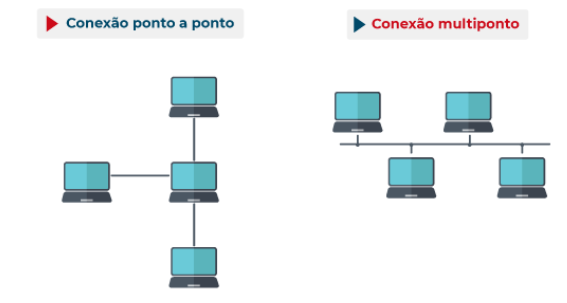
A point-to-point connection refers to a line configuration method that connects two communication devices in just one link. It is, therefore, a unicast connection. There is a direct link between the individual pair and its respective receiver.
If the network is composed of several point-to-point connections, it will be necessary to traverse various intermediate devices. For this reason, in this methodology, it is important to find the shortest possible distance to ensure optimal connectivity.
It is also worth noting that this connection methodology is very present in our daily lives. Some examples include the connection between a computer and a printer, as well as modems and the use of antennas.
What are the advantages of a point-to-point connection?
Firstly, because it connects only two devices, a point-to-point connection is easier to install, more practical, and easy to understand. Furthermore, there is no bandwidth splitting, which contributes to the stability of the connection.
What defines a multipoint connection?
A multipoint connection can be made between two or more devices. In this methodology, a single link is shared among several devices.
In this way, the transmission capacity of the medium—that is, the bandwidth—is divided among all devices connected to the network.
It is also worth mentioning that the multipoint connection is used for passive optical networks. In this case, computers will only execute the messages that are sent and will not move data from one device to another.
This type of connection is used to connect several computers (more than two) in the same network. Thus, it is quite common in the business environment.
What are the advantages of a multipoint connection?
A multipoint connection is also easy to install. Additionally, it features low cost and great reliability. Regarding this topic, it is important to highlight that if one cable is replaced, not all of them will lose connection to the network.
Furthermore, if a signal drop occurs in one of the network equipments, we will not have a connection interruption in the other devices.
What are the main differences between point-to-point and multipoint connections?
Given the definitions presented above, we can say there are some differences between point-to-point and multipoint connections. First, when there is only one link between two devices, it is a point-to-point connection. If a link is shared by two or more devices on the network, it is a multipoint connection.
Another important difference is that in a point-to-point connection, there is only one transmitter and one receiver. In a multipoint connection, in turn, there is one transmitter and there can be several receivers.
Learn more about multipoint connections with DCA.
Was this content addressing the differences between point-to-point and multipoint connections useful to you? Contact us! We are ready to help clarify your questions regarding the topic.
As a Master distributor of Furukawa fiber optic solutions, we guarantee quality and excellence for our clients’ projects. Furukawa is a leader in structured cabling and optical network infrastructure in Brazil and invests heavily in research. Thus, it establishes itself as a center of excellence, capable of offering complete solutions adapted to the most diverse needs in its field of expertise: telecommunications network infrastructure.
Share on Social Media

Read more posts



Transform your infrastructure into a strategic advantage.
 4007-2977
 (41) 3021-1728
 contato@dca.com.br


DCA - Delta Cable Americas 2026. All rights reserved. | CNPJ 00.111.511/0001-80
Developed by

