


How to choose the best option in network cables?

When researching network cables, you come across several nomenclature variations such as: UTP, STP, FTP, and F/UTP, and due to their similarities, they can cause confusion at the time of choice
Let’s understand the differences:
UTP (Unshielded Twisted Pair) is the nomenclature used for a cable twisted in pairs without any type of individual or collective shielding. It is basic, being the most used today in both home networks and large corporate networks, as it is easy to handle and install. Since it has no shielding, its use is not recommended near equipment that can generate magnetic fields such as: electrical network wires, motors, frequency inverters, and also in environments with humidity.
FTP and STP, despite the similar nomenclature, differ from UTP cables because they are cables that have aluminum shielding (FTP – Foil Twisted Pair) or metallic braid (STP – Shielded Twisted Pair), which can involve the entire cable, called global shielding, or each pair, which would be called pair shielding.
Shielded cables can be used in environments with marked electromagnetic interference, as their shielding helps prevent signal loss or even interruptions. They generally have a higher cost but can be the best option depending on the environmental conditions for installation and the client’s needs.
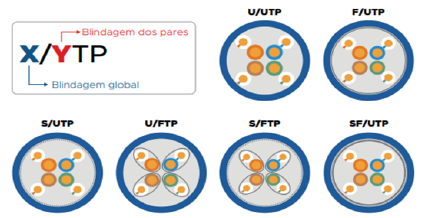
Considering that the shielding can be global, involving all pairs, or individual, done pair by pair, the acronyms gain variations such as: X used for collective shielding and Y used for Individual shielding, resulting in the combinations below:
- U/UTP: has no shielding.
- F/UTP: has collective shielding with aluminized tape, but no individual shielding.
- S/UTP: has collective shielding with metallic braid, but no individual shielding.
- SF/UTP: has collective shielding with metallic braid and metallized tape, but no individual shielding.
- U/FTP: has no collective shielding, but has individual tape shielding.
- F/FTP: has collective shielding and shielding on the pairs with tape.
- S/FTP: has collective shielding with braid and tape shielding on the pairs.
Difference between the 2 main types of materials for LAN cable shielding:
– Metallized polyester tape: it is more effective for high frequencies or radio frequency electromagnetic interference (RFI). In nomenclature, it is known as F/UTP.
– Tinned copper wire braid: It is the most effective type of shielding for low frequencies. In this case, the greater the braid coverage, the better the shielding effectiveness. These cables are more common in SF/UTP and S/FTP configurations.
The choice of shielding type will depend on the application site and the types of noise present in the cable installation environment.
In cases of locations with a very intense presence of EMI noise, the use of fiber optic cables is recommended because, due to their technology, they are totally immune to electromagnetic interference.
We at DCA are at your disposal to clarify any doubts and present the best options in cabling, always following the evolution of technology and offering the best brands on the market. . Get in touch with our team!
Share on Social Media

Read more posts






Transform your infrastructure into a strategic advantage.
 4007-2977
 (41) 3021-1728
 contato@dca.com.br


DCA - Delta Cable Americas 2026. All rights reserved. | CNPJ 00.111.511/0001-80
Developed by

