


APC and UPC: What Are They and What Are the Differences Between Them?
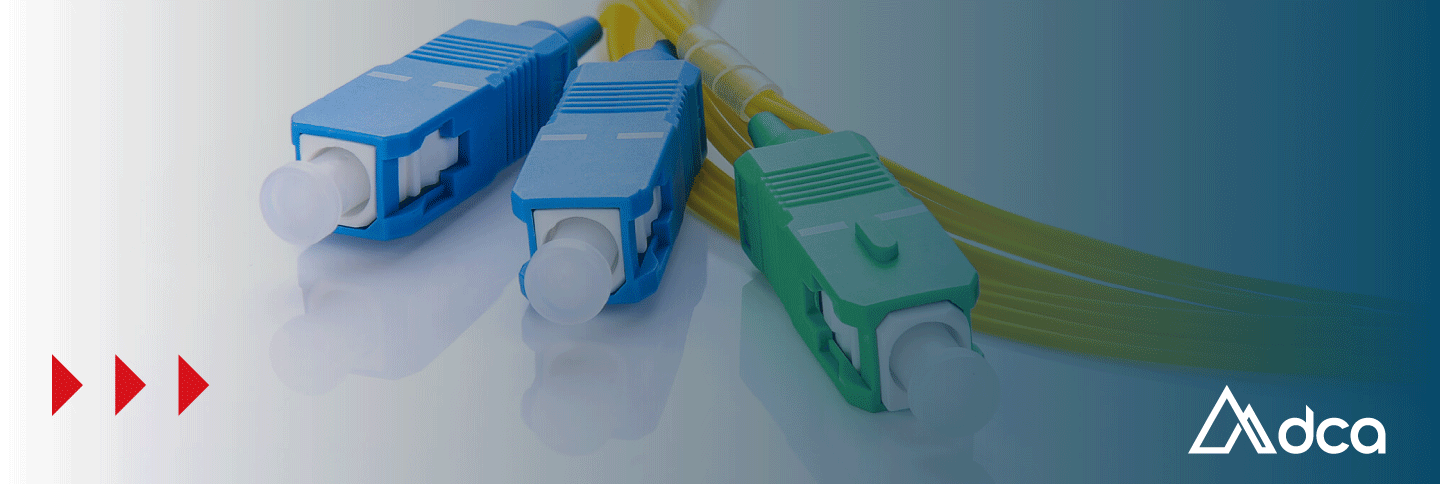
SC connectors with APC and UPC polishing are the two most widely used types on the market, with strong application in field work for fiber optic installation, maintenance, and repair, as well as in FTTx applications. They are also widely used in situations that require quick connections, offering simple assembly and excellent performance. But what is the difference between them?
First, let’s define the concepts:
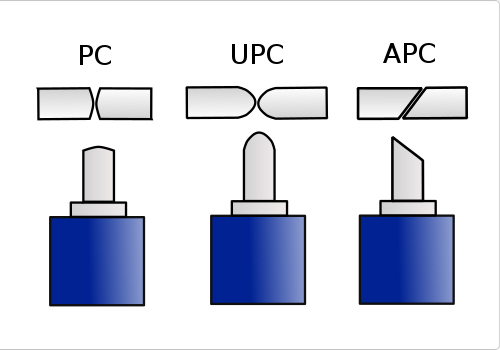
The UPC (Ultra Physical Contact) connector features a convex polish with a smoother surface compared to its predecessor, the PC (Physical Contact) connector.
Compared to the PC type, the UPC connector provides lower return loss, since the contact point between the two fibers is more concentrated in the center. (see figure below)
The APC (Angled Physical Contact) connector, on the other hand, has an 8° angled cut, which makes return loss (the amount of light reflected back to the light source) even lower than in UPC connectors.
See the difference:
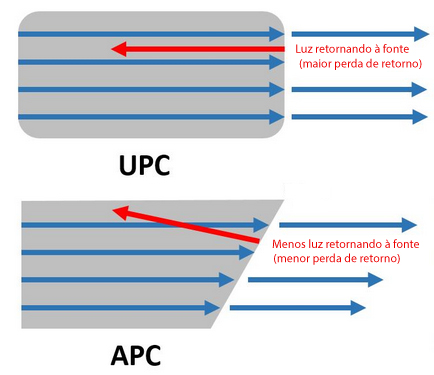
Why is angled reflection better?
When the light beam returns exactly along the same axis as the incoming signal, the light waves can collide, creating signal “confusion” and degrading the quality of the transmitted optical signal.
When the light returns at an angle, however, it reflects multiple times within the fiber filament. Each reflection causes a small level of refraction within the glass. As a result, by the time the light reaches the source again, its strength is significantly reduced, minimizing the risk of interference with incoming optical signals.
What are the practical differences in daily use?
Color coding is the easiest way to identify each connector type: APC connectors are always green, UPC connectors are blue.
In terms of performance, APC connectors deliver better results than UPC due to lower return loss (meaning less light is reflected back to the source).
Does this mean APC replaces UPC and that UPC is outdated?
Not at all.
UPC connectors are more cost-effective and meet the needs of most standard applications, such as CATV, telecom networks, optical equipment, LAN and WAN networks, and data processing systems.
In addition to conventional applications served by UPC, APC connectors are recommended for more complex and sensitive applications, such as high-speed passive optical networks and WDM systems that use multiple wavelengths over single-mode fiber and require high-precision optical signaling.
Share on Social Media

Read more posts






Transform your infrastructure into a strategic advantage.
 4007-2977
 (41) 3021-1728
 contato@dca.com.br


DCA - Delta Cable Americas 2026. All rights reserved. | CNPJ 00.111.511/0001-80
Developed by

