


Infrastructure Cabling!
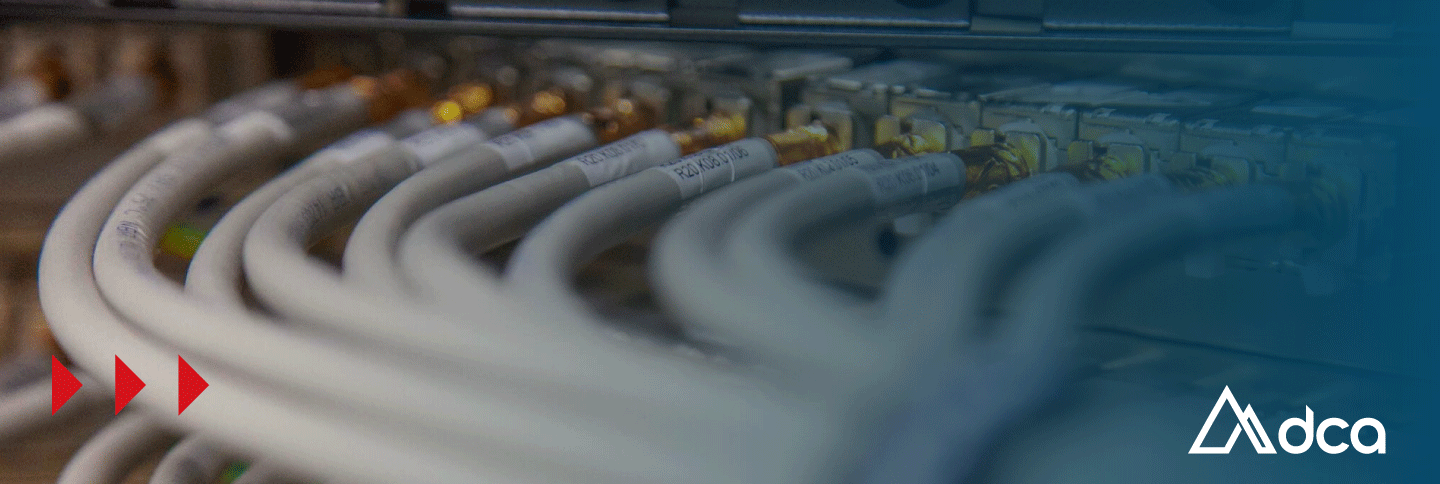
We have previously discussed data centers and their structuring, as well as how important it is to choose the most suitable equipment for your company’s purpose. A key component in infrastructure design, cables must be selected to ensure the proper operation of your entire network and systems.
You may have already heard about structured cabling, and in this post we aim to clarify the advantages of a well-designed cabling project.
Structured cabling is a standardized method of deploying network cables, considering safety standards, best practices, and optimal use of resources. Cabling designed for a company aims to integrate services and allows different pathways within the same structure to connect distinct points. It is essential that a cabling project ensures the infrastructure is capable of operating for a long period of time. These are structures designed to last 10 years or more, supporting processes, servers, routers, and other active data center equipment, regardless of the application.
Currently, there is a lot of discussion about optical cabling. Among its main advantages are lower cost and ease of acquisition—either pre-made or custom-made—through quick-connection solutions, without the need for traditional splicing. Optical cabling is a good choice because it occupies less space, is lighter—which in some cases can reduce the structural load of buildings and increase their lifespan—requires fewer splices, and is the option least affected by electromagnetic interference (EMI) and environmental conditions. Indeed, fiber optics is an excellent choice for high-quality infrastructure.
This does not eliminate the use of other cabling options. Within a data center infrastructure, the cost difference between the most recommended metallic cabling—Category 6A or higher, usually shielded—and optical cabling (MM multimode), such as OM3, OM4, or OM5, is significant. However, depending on the application, both can still be the most suitable choice to ensure superior performance and future-proofing. This can also represent a cost-saving factor, depending heavily on your project and your company’s goals. Another important factor is flexibility and adaptability to change. Technology is constantly evolving, and the emergence of new business solutions is continuous.
Given the importance of structured cabling for IT infrastructure, it is essential to hire a specialized company that can support the development of your infrastructure project and ensure compliance with the ANSI/TIA-942-A standard—Telecommunications Infrastructure Standard for Data Centers. At Delta Cable, we are prepared and constantly seeking new and better technologies for our customers!
Get in touch with our technical team and discover the best solutions for your company.
Share on Social Media

Read more posts






Transform your infrastructure into a strategic advantage.
 4007-2977
 (41) 3021-1728
 contato@dca.com.br


DCA - Delta Cable Americas 2026. All rights reserved. | CNPJ 00.111.511/0001-80
Developed by

