


Fusion Splicer: cladding alignment vs. core alignment
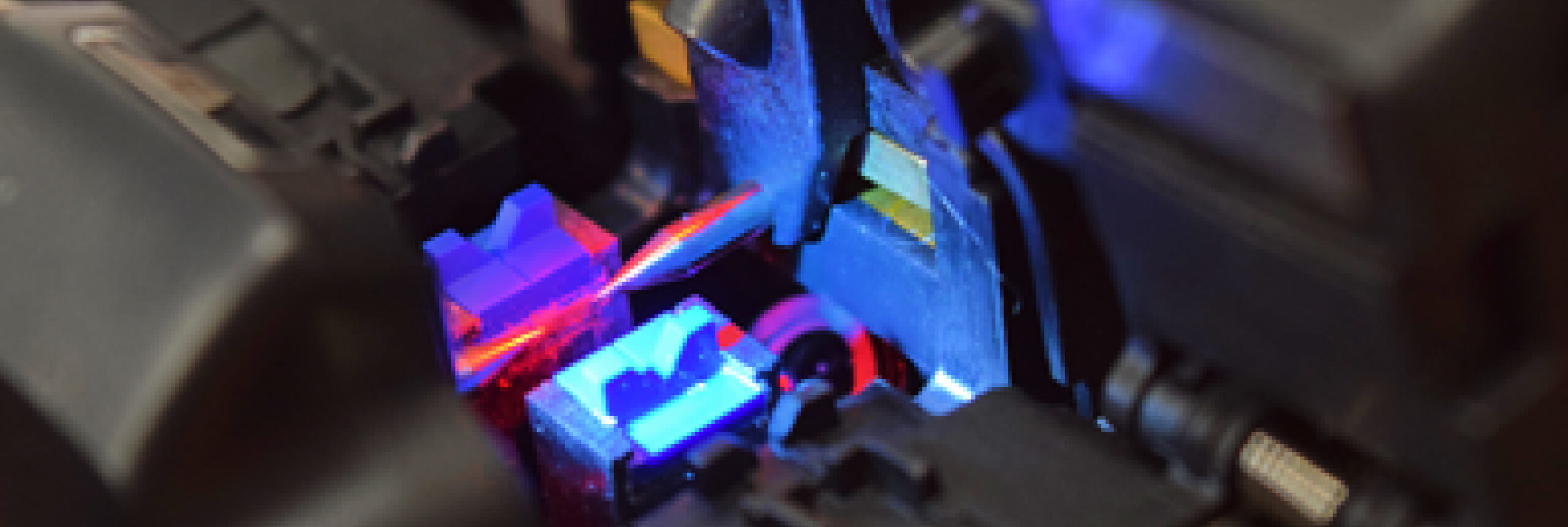
In fiber installation or maintenance, it is common to repair a break or join two points. Moreover, this type of cabling requires a certain level of care. This service is known as “Optical Fusion” or “Fiber Optic Fusion,” performed by equipment called an optical fusion splicer, or simply a splicing machine.
How the SPLICING machine works:
With the help of its motors, the machine positions the fibers closely and uniformly, ensuring the best alignment for the next step: fusion. After this procedure, some tensile tests are carried out to ensure that the splice does not come apart and to verify whether the attenuation is within the expected parameters. To finish, we insert a heat-shrink protector into the splice (also called “sleeves”) and place it in a small oven in the machine, ensuring rigidity through its metal rod.
There are some types of splicing machines available; however, each has its own particularities and alignment processes for fusion. How do you know which is the best fusion splicer to use according to the alignment process?
Learn which is the best alignment option for splicing according to your needs:
Cladding Alignment (2-motor machine)
In this alignment, the V-Groove (the part that aligns the fiber in the fusion machine, V-shaped) remains fixed horizontally and moves only forward and backward, bringing the two fibers together so that fusion can occur. Its system has two horizontal motors to perform this task, and a fusion machine that works this way is generally more affordable. Fusion with this type of alignment does not have high precision, as it considers the cladding rather than the fiber core.
Cladding Alignment – Active V-Groove (4-motor machine)
This is considered an alignment that sits between cladding alignment and core alignment. The difference between the active V-Groove and the fixed V-Groove is that the active version has four motors: two move the fiber forward and backward, and two move it up and down. Even so, fusion with this type of alignment is more effective because it aligns both horizontally and vertically, but it is not as precise since it considers the cladding rather than the fiber core.
Core Alignment (6-motor machine)
Among all alignment types in a fusion splicer, this is the most complex and relies on six motors: two that move the fiber from back to front (horizontal), two from top to bottom (vertical), and two that perform diagonal (longitudinal) alignment of the fiber. This process ensures perfect core-to-core alignment during fiber fusion. Its use is recommended for fiber networks of all sizes, with various fiber types (MM, SM, NZDS, DS, among others), or those using different manufacturing standards. This type of alignment is recommended for mass splicing or splice closures with large fiber counts, offering extremely low losses and fast heating and fusion speeds.
Want to learn more about the fiber fusion process and the different types of machines available on the market? Watch our video and stay up to date with every detail.

DCA is a master distributor of D-Net and offers the best splicing machines for high-precision, high-quality fusion. Get in touchwith our team and choose yours.
By Renan Rederde
Technical Department Manager
Share on Social Media

Read more posts

How to Reduce Your Company’s Network Infrastructure Costs
Read now
Do you know why cable ducts make preventive maintenance easier?
Read now

The Transformation Movement of Industry 4.0
Read now



Get to know the main types of network cabling
Read now
Difference between point-to-point and multipoint connections
Read now
Microtechnology Solutions: the path to an efficient and modern infrastructure
Read nowTransform your infrastructure into a strategic advantage.
 4007-2977
 (41) 3021-1728
 contato@dca.com.br


DCA - Delta Cable Americas 2026. All rights reserved. | CNPJ 00.111.511/0001-80
Developed by

